Cost: (See Booking options)
The course price is for the tuition fees, plus equipment used on the course, and includes the first year’s membership to the Acupuncture Association.
Please remember that you do not have to pay your full tuition fees up front when you enrol. Please note, if you leave the course before the end date, the full course fee is still payable. If you enrol early, you may write to us at [email protected] to request smaller monthly payments over a longer period.
£150 external examiner fee is also due the day before the practical exam; this covers the practical exam, theory exam, case study submission and submission of 2 required essays.
Duration:
18 Months Total: 1 weekend a month over 12 months (as per the dates listed on the individual course) then 6 months given for case studies and 2 x essays. Note: This is 12-18 month course (12 months live training and 6 months clinical case studies which is possible to completed concurrently.)
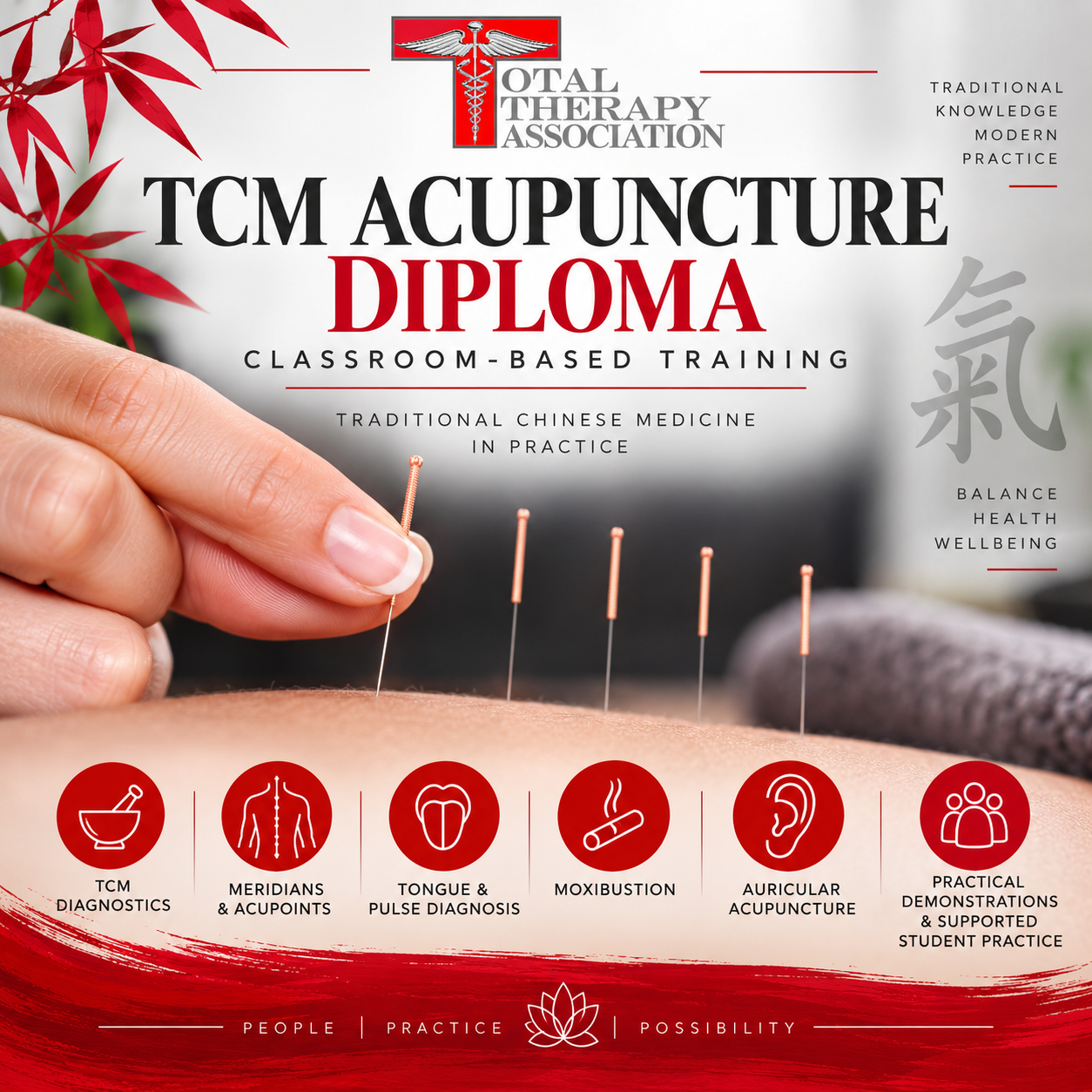
Our TCM Acupuncture Diploma Course teaches the Oriental version of TCM Acupuncture with some family protocols and western updates.
The classroom attendance part of this course is available in Cheshire or London, and runs over a year for one weekend of each month starting on the intake date and running for twelve months including exam dates. The course includes homework and case studies.
Planned Dates for courses: For course dates please check the “Additional Info” tab.
Contraindications and Health and Safety
Ethics
Sanitisation
Origins of TCM (Traditional Chinese Medicine)
Chinese Philosophy
Fundamental Substances
Causes of disease
Zang Fu Organs
Needling angles and Chinese measurements
24 Hour Qi cycle
The Standard 12 Meridians
Two of the extra-ordinary meridians
Western food and diet
Chinese food and diet
Yin and Yang theory
Functions of the organs
Differentiations of the organs
The Shen and the 7 emotions
Treatment principles
Nerve function and testing
Qi, blood and fluids
The 6 extra-ordinary organs
8 Diagnostic principles
TCM diagnostic patterns
Vital substances
Bi-syndromes
Differentiation via the 4 levels
The 6 evils
Complex diagnostic theory
Standard tongue diagnosis
Standard pulse diagnosis
Advanced Japanese / ancient pulse diagnosis
Differentiation of syndromes via the 8 diagnostics
Specific organ pattern diagnostics
TCM disorders
Balancing of the Yin and Yang meridians via pulse
Combined patterns of Chinese Medicine
Internal Zang-Fu relationships
The ancient 9 needling techniques
Further extraordinary vessels
5 element theory
Wei syndromes
The dan tien
The 4 pillars of Chinese Medicine
Diagnosing live clients in clinic
Clinical case study discussions
Post treatment care
Consent forms
Patient records
Legal responsibilities
Practical demonstrations
Observed student practice
Discussion with students on client issues as they arise
We are proud to share that we cover the 8 points of measurement of the best UK Acupuncture Courses as laid out by the CEO of the British Acupuncture Federation in his article published on the Acupuncture Association web-site here: Click Link.
1. Accreditation and Licensing: This course is accepted by the Acupuncture Regulatory Authority (ARA) and the Federation of Holistic Therapies (FHT) and accredited under licence by Yanagi Ryu of Japan. Our Diploma is accepted by most insurance companies in the UK.
2. Curriculum and Training: Our TCM Acupuncture syllabus includes Moxibustion, Auricular Acupuncture, Battlefield Acupuncture, Tendon Acupuncture, Chinese Bloodletting and diet principles.
3. Faculty and Credentials: The faculty and other staff credentials can be accessed in the “Meet the Team” section of our website. All our staff, not just faculty, are experienced, practising therapists, and all involved in the Acupuncture course are experienced, practising Acupuncturists.
4. Clinical Opportunities. We can run student clinics in collaboration with our Acupuncture Class each year, and also staff from the Acupuncture course invite students to shadow them in class, we share cases of real people, practice diagnosing real people, and our practical diagnosis exam is done on a real person who comes into class to talk to the students about their case before being diagnosed.
5. Research Opportunities: Part of our assessment is writing 2 essays which need to be thoroughly researched, and the higher marks go to the people who push the boundaries and attempt to come up with new treatments or treatment methods in TCM, or take existing methods to new areas.
6. Student Support Services: Our student support is second to none. We are always on the end of the phone for urgent support, on Whatsapp for less urgent and email for admin queries or general enquiries. We also have a lifetime access Student Forum on Facebook which the teachers frequent but, these days, rarely have to help out on, as qualified students usually chip in pretty quickly with experience, tips and tricks and even offers of help. Not only that, but we also run a monthly Zoom call for Acupuncture students, which previous students are also invited to, so we can check progress and make sure everyone is on track with our monthly online classes which often involve a Quick Quiz on subjects covered in the previous classes.
7. Reputation and Alumni Success: If you want to check our reputation, check our Facebook and Google reviews. We are proud of our reviews, and we are also proud of our amazing Alumni. Some even have awards for their success in helping others with acupuncture, and many are willing to chat to you, if you want a list of contacts, please email, we ask each one individually each time so they are always happy to chat. Our courses have a pass rate of between 75 to 90%. This sounds like it’s a challenge, but if you work hard and practice your practical skills each month, then it’s much easier to get into the pass zone. We also offer free resits to anyone who hasn’t passed, and discuss the reasons for this with them.
Our course has approx a 50% practical training ratio, to enable this we give homework, and our student support Zoom calls make sure everyone is on track each month. Our students also do a cautionary needling test part way through the course, and these skills have to be repeatable therefore remembered as part of natural needling methods.
8. Location and Accessibility: Our training centre is very close to Macclesfield Train station, which is on the main line between London and Manchester, and is over the road from the local Travelodge, plus we have some great Airbnb’s nearby as well as other hotels. We have hot drinks making facilities, microwaves, a fridge freezer and even a shower for student use. Cars parks are nearby, and the shopping centre is only 5 minutes away.
The prerequisite on this course is an A&P qualification.
If you do not have an A&P qualification, we can recommend an online course you can complete prior to training.
You must be 18 years or older and understand spoken and written English. You must consent to giving and receiving manual and acupuncture therapy.
Planned Dates for courses:
February 2027 Intake – London Location: 8-10 Boston Place, Marylebone, London NW1 6QH
(All dates in this section are one complete course)
12th to 14th February 2027 (3 days)
20th to 21st March 2027 (2 days)
3rd to 4th April 2027 (2 days)
1st to 2nd May 2027 (2 days)
5th to 6th June 2027 (2 days)
3rd to 4th July 2027 (2 days)
7th to 8th August 2027 (3 days)
4th and 5th September 2027 (2 days)
2nd and 3rd October 2027 (2 days)
6th and 7th November 2027 (2 days)
4th and 5th December 2027 (2 days – Exam dates)
Online sessions once a month in the 3rd week of the month at 8pm (weekday to be voted on in class) Exams
Diagnostics Exam 4th December 2027 (Times TBC)
Theory Exam 5th December 2026 (Times TBC)
September 2026 Intake – Macclesfield
Location: Riverside, Sunderland House, Sunderland Street, Macclesfield, SK11 6JF
(All dates in this section are one complete course)
Intake Weekend: 25th to 27th September (3 days)
24th and 25th October (2 days)
21st and 22nd November (2 days)
12th and 13th December 2026 (2 days)
23rd and 24th January 2027 (2 days)
27th and 28th February 2027 (2 days)
13th and 14th March 2027 (2 days)
24th and 25th April 2027 (2 days)
22nd and 23rd May 2027 (2 days)
26th and 27th June 2027 (2 days)
Exam 1 (Diagnosis / Theory) 24th July 2027
Exam 2 (Diagnosis / Theory) 7th August 2027
“This course in Traditional Chinese Acupuncture was fab for me, very hands on with practical training and a really comprehensive overview of the theory of TCM theory and acupuncture. The teachers were passionate in the teachings and try and squeeze as much information into the course as possible. I really enjoyed the course and feel that I have learnt a lot within the year.”Kaye Lui“Great course. It gave me the depth in Chinese Medicine I was previously lacking from the other course I did. The hands on experience has really helped me to be confident in my clinical skills. I would recommend anyone who wants to start their journey, or already qualified to give this course and their other shorter courses a go.”Laura J, Functional Acupuncture, Oldham.
“Although I had a degree in biological sciences, acupuncture was completely new to me when I started this course. I found the staff to be friendly and encouraging right from the off. Our course ended up being partially through Covid lock-down but the theory sessions were taken on line and rather than reduce the number of sessions they increased them, which was fantastic. By the time lock-down had ceased we were all much more knowledgeable and ready to focus on the practical aspects. We received support with any queries we had throughout the year. The teachers were happy to stay longer during the sessions to practice acupuncture if students were unsure of certain points. I felt supported and listened to throughout. They gave above and beyond what they had to do. I felt the course not only taught me acupuncture but helped me grow as a person. Thank you Total Therapy Training.”Sarah Lynch, Stockport, Greater Manchester
I really enjoyed my time spent training with Total Therapy.
The course offers a great foundation in Traditional Chinese Medicine and offers fantastic essential hands on training.
The support they offer is wonderful, they walk with you every step of the way and are always on the end of the phone to answer any questions 7 days a week.
If your looking to start a career in Acupuncture I would highly recommend this course. However it is a lot of fun but it’s important to make time every week to revise the theory and material provided as well as attending in person each month.
Acupuncture is a wonderful rewarding career, if your committed to learning and practicing your skills you will not be disappointed.
Traditional Chinese Medicine is a fascinating subject and the results you get will blow your mind. For myself I’d already started a full-time degree in Acupuncture. I decided to complete my third and final year with Total Therapy, I have never regretted my decision, they put the magic back into my learning experience!.Leah Cross – Therapy Rooms , Pembrookshire
FAQS
I haven’t done any other therapy before, so I’m a complete beginner, can I come on this course?
We require a basic manual therapy qualification and anatomy and physiology knowledge as we begin with needling on the first weekend and confidence in dealing with clients and the physical body is essential. We can suggest other courses that may interest you should you require a bodywork qualification that enables you to take this course.
What style/type of Acupuncture is taught on this course?
This course teaches full traditional Chinese medicine and Acupuncture (TCM). We also discuss aspects of, and differences in modern and ancient Acupuncture.
Can I get insured and practice on passing this course?
Yes, you are responsible for any local area authority licensing and getting insured, but this course is accepted by top UK insurance providers some of whom also insure in certain countries abroad.
None of the dates suit me and I don’t want to do the full syllabus, do you do private courses?
Yes we do, as this is a course done over a number of months, we can’t teach the whole of this as a private course, however we can teach some aspects of it in private sessions. If you send us an email to [email protected] we can give you a quote for private training at our training centre or at your own premises.
Who is it for?
This course is for any qualified therapist who already does bodywork therapy and has an anatomy and physiology qualification. If you have a grounding in Chinese Methods this is highly advantageous but not required.